The Smart Prague Index yearbook has been published since 2017 by OICT, a city-owned company. Using specific measurable indicators and annual evaluation, the Smart Prague Index analyses Prague's development, tracks trends, summarises the capital city's achievements and serves as a valuable basis for its further development.
*All of the data used in the Smart Prague Index come from individual city organisations, Prague city districts and other partners who are responsible for their accuracy.
The Smart Prague Index tracks Prague's progress in three agenda areas defined in the Smart Prague Concept.
The Smart Prague Concept for 2030 sets out the basic requirements for implemented projects. The Smart Prague Index (SPI) methodology was created to successfully track the fulfilment of the Smart Prague strategy. The methodology is based on the global Cities in Motion Index (CIMI) and serves as a tool for measuring the "overall smartness" of Smart Prague projects. The SPI maps the baseline, tracks the development of Prague's "smartness" over time, monitors impacts and evaluates the success of implemented projects in terms of the Concept's principles. The methodology also helps identify weak points and evaluate new approaches to solving problems.
All smart city solutions should be based on five basic principles. "Smart" cities are:
The goal of smart city projects is sustainable growth and a high quality of life for residents.
More about the Smart Prague Concept
We evaluate the fulfilment of the Smart Prague Concept 2030 every year through the Smart Prague Index yearbook, i.e. a set of indicators that measure Prague's progress in the key areas in which it should develop as a smart city.
Innovation culture represents a set of values, expectations and practices that actively and deliberately create an environment supporting innovation, encouraging new ideas, creativity and experimentation. An important part of this is learning from mistakes and building a knowledge base, to which both the Smart Prague Index (SPI) and its methodology for tracking and evaluating year-on-year data from a set of indicators that map the city's progress contribute, as well as the emerging concept of the Smart Prague Centre (SPACE), which should contribute to the development of experiential learning.
We evaluate how well the Smart Prague Concept 2030 is being fulfilled every year through a series of indicators that measure Prague's progress in the key areas in which it should develop as a smart city.
The innovation management service is a pilot service aimed at increasing the quality and efficiency of the process of preparing Smart City projects. The innovation management team actively seeks out opportunities in new technologies and trends that target end-user needs. The aim is to ensure that the proposed innovative solutions are relevant, user-friendly and respond to the real needs of the city's residents.
Innovation and technological infrastructure - People and improving their quality of life come first when implementing new solutions. However, technology is not neglected and serves as an essential tool for collecting, transmitting and visualising data, which helps build a knowledge base and enables better decision-making and planning. This includes both data platforms that make data accessible to city representatives, as well as the development of new digital tools and the use of artificial intelligence (AI).
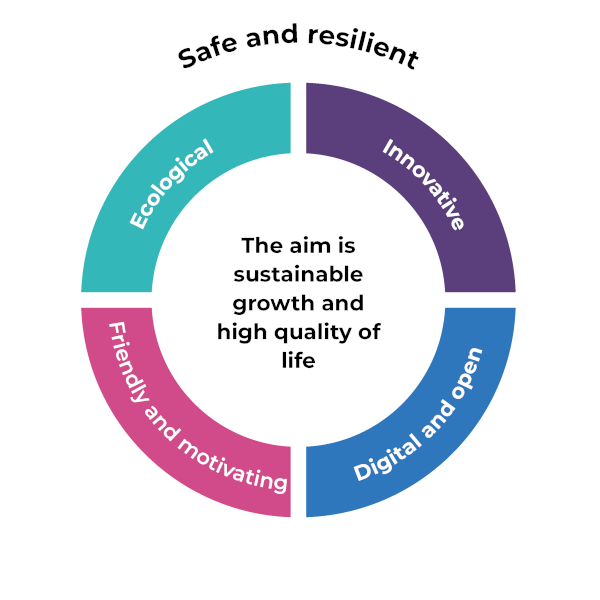
Reduces pollution and improves
the environment (e.g. through
management of energy and
material consumption, including waste)
Builds on new business
models and uses modern
materials and technologies
Involves city residents and
stakeholders, including the business
sector, in its projects
Is supported by information
systems that are efficiently
integrated; the data generated
becomes, to the greatest extent
possible, open data

Independent, complex, and clear structure method

A tool for following the Smart Prague projects implementation success rate

Source of information for planning (heading) of suitable future projects
An overview of the Smart Prague vision fulfilling
Every year, "smart" cities are compared on the basis of specific criteria. The Cities in Motion Index (CIMI) uses these key indicators to compare cities across the world and its regions, and the Smart Prague Index (SPI) is based on this clear and simple methodology. A shift in the ranking of cities in selected CIMI areas indirectly reflects a shift in the relevant SPI areas, as there is a correlation between the CIMI and SPI indicators in these areas.
While we can compare the "development" of Prague using the SPI methodology due to its consistency, the number and type of selected CIMI indicators varies slightly from year to year, which makes it impossible to offer year-to-year comparisons for individual cities. However, out of more than 180 regularly compared cities, Prague has been in the top ranks since 2017, specifically in the top quarter of all assessed metropolises. Each year it then ranks as the leading city in the "Eastern Europe" region.
The SPI and CIMI assessments are conducted annually; due to data availability, the SPI assessment is conducted approximately halfway through the calendar year.
The IMD Smart City Index is one of the world's leading rankings of "smart cities". It is compiled by the Institute for Management Development (IMD) and the Singapore University of Technology and Design (SUTD). The index ranks cities worldwide based on their "smartness", where "smartness" is defined as the extent to which cities use technology to improve the quality of life of their residents. The ranking is based on citizen surveys and reflects how well cities meet the needs of their residents.
The index is divided into two main pillars: Structures and Technology. Structures assesses cities based on infrastructure and key services. Technology assesses how well cities use technology and innovation to improve residents' quality of life. The IMD Smart City Index also includes citizen feedback - how well technology serves their needs and improves their lives.
In 2025, Prague improved its position, ranking 12th out of 146 cities assessed. On the "letter" scale, where cities are compared with one another within their maturity groups, Prague again reached the AA level, while still remaining in the highest overall maturity category. Year-on-year, Prague's HDI index, which measures the level of human development, also increased.
| 2019 | 2020 | 2021 | 2023 | 2024 | 2025 | |
|---|---|---|---|---|---|---|
| Rank | 8 | 4 | 10 | 14 | 15 | 12 |
| Smart City rating (AAA-D) | A | AA | A | AA | ||
| Factor ratings - Structure (AAA-D) | A | A | AA | |||
| Factor ratings - Technology (AAA-D) | A | A | AA |
*All cities are ranked both by their order of fulfilment of individual indicators and on a letter scale, which ranks them according to how they compare with other cities within the group they belong to based on their level of maturity. By maturity, cities are divided into four groups, within which mutual comparisons are made. The letter scales are for group 1 (most mature): AAA-AA-A-BBB-BB; group 2: A-BBB-BB-B-CCC; group 3: BB-B-CCC-CC-C; and group 4 (least mature): CCC-CC-C-D.